
T-Scan Novus
SKU : TK-TSCAN NOVUS
0 Sold
Short Description
Dentistry’s premier clinical hardware and software system designed for objective, dynamic occlusal analysis. Moving far beyond traditional articulating paper, it captures real-time relative force data and microsecond-level timing during mandibular closure to help clinicians precisely balance bites, protect complex implant restorations, and diagnose temporomandibular disorders (TMD).
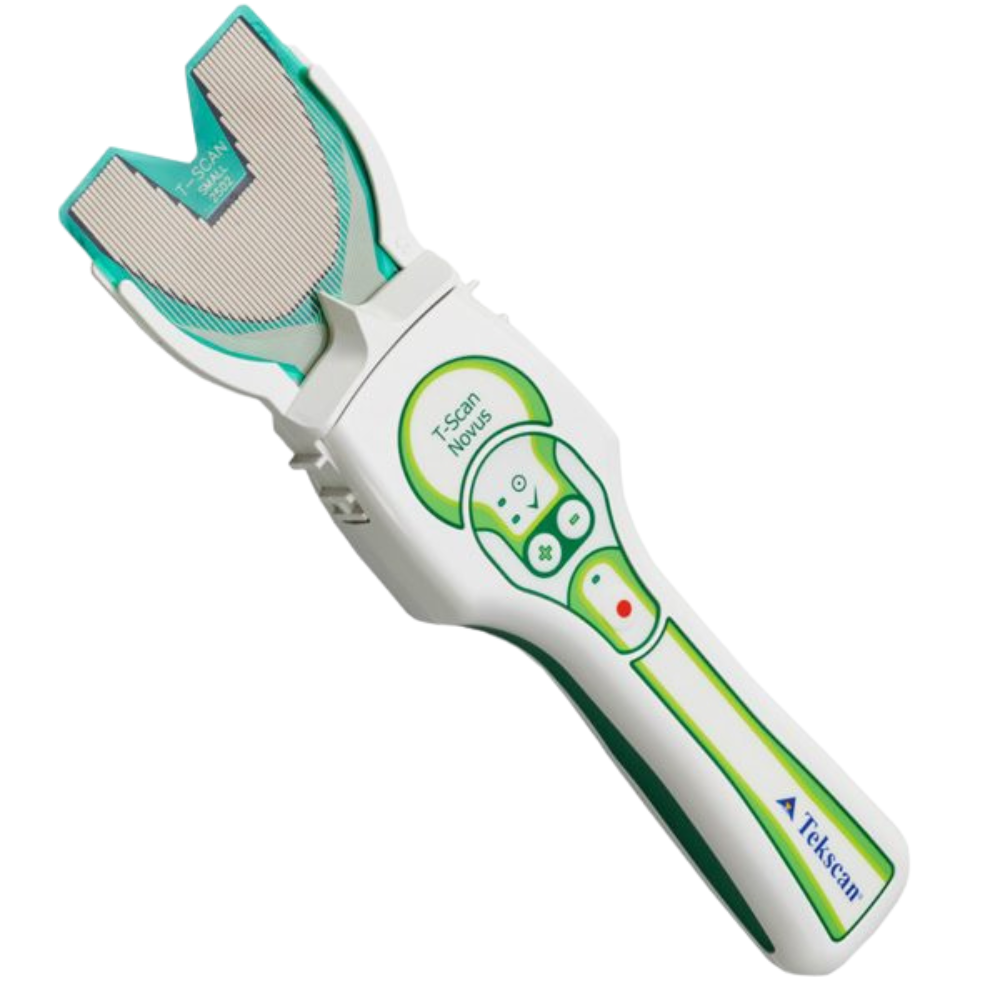
T-Scan™ Novus™
Dynamic Force and Timing Metrics: Unlike static articulating paper which only shows where teeth touch, the T-Scan Novus records the entire "occlusal movie." It calculates exactly which tooth makes first contact, reveals how force distributes across the arches over time, and maps the trajectory of the Center of Force (COF), allowing clinicians to pinpoint destructive high spots instantly.
Ergonomic USB-Based Handpiece: Features a lightweight, handheld acquisition device that connects directly to standard operator PCs via a 3-meter USB 2.0 cable. Built-in chairside controls allow the user to adjust sensor sensitivity settings and trigger or pause multi-second recordings directly from the patient’s side, maximizing operational efficiency.
Ultra-Thin High-Resolution Sensors: Employs patented, grid-patterned tactile sensors measuring just 0.1 mm in thickness, preventing jaw closure interference. Packed with over 1,100 high-density sensing elements (sensels), the substrate captures fine cusp-to-fossa details and can be cold-sterilized for multi-recording use on a single patient.
Digital Impression Overlay (DIO): The proprietary analysis software supports direct STL file imports from modern intraoral scanners. This combines three-dimensional anatomical geometry with real-time pressure animations, allowing the dental team to visualize force loads directly on the patient's digital tooth structures.
Implant Loading and Finishing Safeties: Equipped with real-time warning algorithms that highlight premature or excessive force patterns on delicate structures like healing implants, extensive cosmetic veneers, or fresh multi-unit crown and bridge configurations. This protective baseline data drops laboratory remake rates significantly.
Biometric System Integration: Fully compatible with companion neuro-muscular diagnostic hardware, including surface electromyography (BioEMG™) and joint vibration analysis (BioJVA™), providing a comprehensive picture of structural joint, muscle, and tooth interaction.
Technical Specifications:
System Type: Digital Occlusal Analysis System (Hardware Handle + Software Suite).
Data Capture Speed: 175 Hz (Standard Mode) up to 500 Hz (Turbo Mode).
Sensor Grid Density: 1,370 active sensels (Large) / 1,122 active sensels (Small).
Sensor Thickness: 0.102 mm (4 MIL).
Connectivity / Power Source: USB 2.0 Standard Type A / Bus-Powered (5VDC, max 200 mA).
Handpiece Dimensions & Weight: $183 \times 57 \times 31\text{ mm}$ / 0.23 kg (0.5 lbs).
Sensor Support Frame: Autoclavable polysulfone resin with built-in incisal guide positioners.
Tooth Numbering Formats: Universal, FDI/ISO, Palmer, Haderup.


 MakeWebEasy